
 By
By 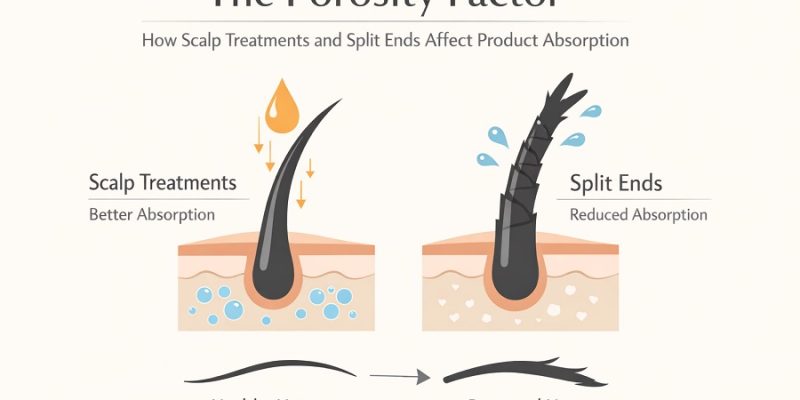
In the pursuit of hair restoration, the primary focus is almost always on the scalp. However, the condition of the hair fiber itself—specifically its porosity and the presence of split ends—plays a significant role in how effective a clinical routine becomes. In 2026, trichologists are increasingly discussing the “wicking effect,” where the state of the hair shaft can inadvertently interfere with the absorption of topical treatments.
Understanding how to use minoxidil correctly requires an understanding of hair histology. By managing the health of your hair from root to tip, you ensure that your clinical treatment reaches the follicles where it is needed, rather than being wasted on damaged hair fibers.
The Science of Hair Porosity
To understand the relationship between scalp treatments and hair health, we must first look at the cuticle. The cuticle is the outermost layer of the hair shaft, consisting of overlapping scales similar to shingles on a roof.
-
Low Porosity: The cuticle scales lie flat and tight. While this makes hair shiny, it can also make it difficult for moisture or treatments to penetrate the shaft.
-
High Porosity: The scales are raised or damaged, often due to heat styling, chemical processing, or environmental stress. High porosity hair absorbs moisture quickly but loses it just as fast.
When hair is highly porous, it often manifests as split ends (trichoptilosis). These occur when the protective cuticle is completely stripped away, leaving the inner cortex exposed and frayed.
The “Wicking Effect”: How Split Ends Hijack Your Treatment
A common mistake when learning how to use minoxidil is failing to protect the mid-lengths and ends of the hair during application. If the hair shaft is highly porous or riddled with split ends, it acts like a sponge.
When a liquid or foam treatment is applied to the scalp, “wicking” can occur. Capillary action draws the liquid away from the skin and along the hair shaft. Because split ends have a high surface area and lack a protective barrier, they absorb the solution greedily.
The Consequences of Treatment Wicking:
-
Reduced Scalp Absorption: The active ingredient is diverted away from the hair follicle, meaning the “clinical anchor” cannot perform its task of vasodilation effectively.
-
Increased Brittleness: Most topical hair loss solutions contain a delivery vehicle (such as alcohol or propylene glycol) designed to penetrate the skin. While safe for the scalp, these agents can be drying to the hair fiber. On already damaged split ends, this can lead to further “weathering,” making the hair more prone to breakage.
Strategic Application: How to Use Minoxidil Without Damage
To maximize regrowth while maintaining the aesthetic quality of the hair, users should adopt a “Zonal Care” approach. This ensures the treatment stays on the scalp and the hair length remains protected.
1. The Pre-Treatment Barrier
Before applying your hair loss solution, apply a small amount of a lightweight hair oil or a “sealing” serum to the mid-lengths and ends of your hair. This acts as an occlusive barrier. If any of the topical treatment accidentally runs down the hair, the oil prevents it from being absorbed by porous split ends.
2. Precision Mapping
Instead of spraying or pouring the solution generally over the head, use a dropper or a targeted foam application. Part the hair in sections and apply the solution directly to the skin. By keeping the product focused on the “follicular niche,” you reduce the risk of it traveling down the hair fiber.
3. The Dry Scalp Protocol
The absorption of a vasodilator is most efficient on a dry scalp. However, it is equally important that the hair itself is not damp. Water on the hair shaft can increase its conductivity, allowing the treatment to slide away from the roots and toward the ends.
Why Managing Split Ends Supports Growth Goals
It may seem counterintuitive, but trimming split ends is a vital part of a hair regrowth journey. While split ends happen at the bottom of the hair and growth happens at the top, the two are linked by the concept of “Length Retention.”
If a hair regrowth treatment is successfully producing new, healthy hair at the root, but the ends are splitting and breaking off at the same rate, the user will perceive “zero growth.” This often leads to the false conclusion that the treatment is failing.
The Anatomy of a Split
Once a hair fiber splits at the end, the tear can travel up the hair shaft toward the scalp, much like a “run” in a pair of stockings. If this split reaches the mid-shaft, the hair will break. By keeping the ends “sealed” and healthy, you ensure that the density gained at the scalp is reflected in the overall length and volume of the hair.
2026 Innovation: Formulation Matters
In 2026, the best clinical formulations have evolved to be more “fiber-friendly.” Many modern foam treatments have been engineered with a lower alcohol content and added moisturizing agents. These “cosmetically elegant” formulas are less likely to cause the “crunchy” or dry texture that was common with older liquid versions.
When choosing how to use minoxidil, selecting a foam formulation is often the better choice for those concerned with split ends. The foam stays where it is placed, reducing the “drip” factor and ensuring the medicine stays on the skin rather than the hair.
The Holistic Routine: Step-by-Step
To bridge the gap between clinical efficacy and hair fiber health, follow this 2026 Trichology-approved routine:
|
Step |
Action |
Purpose |
|
Step 1 |
Detangle with a wide-tooth comb. |
Prevents mechanical breakage. |
|
Step 2 |
Apply a protective oil to ends. |
Shields split ends from treatment “wicking.” |
|
Step 3 |
Apply 5% treatment to the scalp. |
Stimulates the follicle (The Anchor). |
|
Step 4 |
Gently massage the scalp only. |
Increases blood flow without ruffling the hair cuticle. |
|
Step 5 |
Allow 4 hours for total absorption. |
Ensures the “pro-drug” is converted to its active sulfate form. |
Conclusion: Balancing Scalp Science and Fiber Health
The journey to thicker hair is a dual-track process. On the one hand, you must use a clinically proven hair loss solution to stimulate the follicles. On the other, you must manage the “Porosity Factor” to ensure your hair fibers can withstand the treatment process.
By understanding how to use minoxidil with precision and protecting your hair from split ends, you create a synergistic environment for success. You aren’t just growing hair; you are preserving it. In 2026, the most successful hair restoration stories are those that treat the scalp with the rigor of medicine and the hair length with the care of a scientist.







Comments